What War?

The Iran war is not over, but don’t tell the stock market. What looked like the beginning of a downturn in March quickly reversed in April. Now we’re back making all-time highs again.

Why?

It appears the fear of high oil and gas prices brought about by the conflict has been pushed aside by the hope and excitement of the unending demand for the AI buildout.

Fear and excitement have a funny relationship.

The other day my son Charlie and I were riding our bikes. He was flying down the street on his bike faster than I’ve ever seen him go. I told him to be careful and slow down, but he’s three…

The fear was there, it just wasn’t winning. His excitement had taken over and sure enough… he crashed. His best “owee” yet!

Scraped up, and a little shaken, but not done.

A couple days later, he was right back out there, riding fast again. Not because the risk disappeared, but because the excitement returned.

Markets work the same way. Shaking off the fear in search of new excitement. 

The Fear

High oil and gas prices create concern about a slowdown in consumer spending. If we spend more at the pump, we have less for food, clothing, housing, entertainment and everything else.

When the consumer pulls back, companies earn less, and stock prices typically follow.

That fear is real. It hasn’t gone away.

The Excitement

At the same time, a powerful new wave of excitement is building around AI.

What most of us use today, asking tools like ChatGPT questions is often called generative AI. It answers.

The next phase, often called agentic AI, does more than answer, it acts. It can plan, execute tasks, and get things done.

That shift matters. Jensen Huang, CEO of NVIDIA, recently said the compute needed for agentic AI could increase dramatically, on the order of “1000% more” than earlier systems.

Whether that number is exact or not, the implication is clear: building this next phase of AI will require massive infrastructure in chips, data centers, energy, and connectivity.

That idea has sparked significant investment in companies tied to the buildout.

What’s Driving the Market

Right now, the excitement around AI is dwarfing the fear tied to oil, war, and economic slowdown.

Just like my son on his bike, the risk hasn’t disappeared, it’s just not what’s driving behavior.

And when excitement is in control, stocks move faster than expected.

What Should We Do?

Our Moderate Funds Portfolio is capitalizing on the run-up in stocks so far this year. No change is needed here. We will continue to benefit as markets respond to this renewed optimism around AI. When stocks inevitably cool off, which is normal, the fund structure should help limit downside relative to the broader market.

The Growth Stock Portfolio, however, needs some adjustment.

This new demand for AI is pushing companies involved in the buildout significantly higher, while the rest have lagged. Our portfolio benefited early through positions in NVIDIA and Taiwan Semiconductor Manufacturing Company, but we believe it’s time to broaden that exposure.

We are currently focused on:

  • GE Vernova (GEV): benefiting from increased power demand tied to AI infrastructure
  • Corning (GLW): producing fiber optic connections for data centers
  • Micron Technology (MU): a key provider of memory needed for AI systems

These companies have already seen strong performance, but the underlying demand driving them may persist. Our goal is to position clients to participate in that long-term trend.

At the same time, we’re trimming winners that have done well. Just this week we trimmed Fortinet FTNT a cyber security company that had fantastic earnings. We’re also reducing underperformers that have held us back this year. Selling some of these companies allows us to build cash and take advantage of the next meaningful pullback.

Fear and excitement don’t take turns, they compete, and the excitement surrounding AI is winning. My job is to help clients participate in the excitement without being reckless.

That’s also my job as a dad, but clearly I need more work in that area! 

We hope everyone made it through tax season ok! We’ve called most clients to check-in and give an update but we still have a few more to talk with. If you need to call us, you may talk to our newest intern Palmer Smith. Please say hi! He graduated from Willamette University with a Bachelors in Business Administration and is headed back in the fall to get his MBA. 

Thanks for reading,

Tim Porter, CFP®

Divergence

Over long periods of time, markets and headlines tend to move together. Fearful news often leads to falling markets, while optimism usually means rising prices. But every so often, we experience seasons of divergence.

We find ourselves in one of those seasons again.

Markets are sitting at all-time highs, while the tone of daily news and social media feels unsettled—marked by social tension, geopolitical uncertainty, and a steady drumbeat of alarming headlines. It’s natural to ask: How can Wall Street be rising when things feel so uneasy on Main Street?

This is exactly the question we were asking five years ago when COVID and protests dominated the news while the stock market was hitting new highs. 

At the time, we pointed out that markets are not a scorecard of today’s headlines. They reflect expectations about the future, not the emotional intensity of the present moment. We noted that news and social media often magnify extremes, while markets quietly price probabilities. The takeaway then—as now—was that emotional reactions are rarely rewarded, but patient,  disciplined investors tend to be.

So how can we be patient and disciplined investors? By not being overly aggressive. 

Overly Aggressive

11 years ago the Seahawks were overly aggressive. They were in the Super Bowl playing the Patriots and needed a touchdown to win. Did they play it safe and hand the ball to a running back nicknamed “Beast Mode?” Unfortunately no, they were overly aggressive, threw a pass (picture), and it ended in tragedy. The Patriots intercepted the ball and the Seahawks lost. My heart was broken!

Wouldn’t you know it, but guess who played in the Super Bowl again last week? Seahawks and Patriots. Fortunately, the Seahawks did not make the same mistake! 

That said, when stocks have rallied multiple years in a row, when returns in accounts are above average, and everyone is optimistic (financially), we DO NOT want to be overly aggressive. It’s now time to be patient and disciplined. 

The last three years have been great. The returns from the S&P 500 according to Morningstar were: 26% in 2023, 25% in 2024, and 18% in 2025.

A three-peat of double digit growth is rare. It doesn’t mean it can’t continue but a four-peat is even rarer–only happening twice in the last 75 years. 

We should be cautious moving forward.

Patient

When we get a new account, or have new money to invest, we don’t typically invest it all at once, especially when the market is at all time highs. We only invest 1/3 to 1/2 at the start, then we wait (sometimes six months) for a meaningful pullback to invest the rest. In other words, we’re being patient investors, not overly aggressive.

Our list is growing of clients that have large cash positions to invest in stocks. We are being patient and waiting for a good opportunity. The last opportunity we took advantage of was April, 2025 during the “tariff tantrum” when stocks dropped 20%. 

Disciplined

For everyone else that’s already invested, you’re winning the game! You have had several years of above average growth and hopefully feeling good about your balances. No reason to get overly aggressive and start throwing Hail Marys!

It’s time now to be disciplined in our allocations, diversification, and spending. Here’s how we’re doing that:

Cash – How much should we have in cash?

Cash is low risk money in the accounts that’s typically invested in money market funds. When we’re hitting new highs, like we are now, we want a lot in cash. When markets drop, we want to use that cash to invest in companies and funds that have gone down and have a potential to rebound. 

Cash positions are as high as 20% in our Growth Stock Portfolio right now. That gives us the ability to buy some good stocks at lower valuations when the market drops. 

Bonds – How much should we have in bonds?

Bonds keep the portfolio balanced. We reduced exposure to bonds when interest rates were low, like they were in 2008-2022. Now that rates look to have peaked, we are looking to raise the allocation to bonds once again. This also help us from being overly aggressive.

Stocks – How much should be in equities/stocks?

Stocks help the accounts keep up when markets are doing well. We want to reduce our stock exposure at the top of the market, and then add to our stock allocation when markets drop—like we did in April last year. 

We have ~80% in stocks in our Growth Stock Portfolio and ~60% stocks in our less aggressive Moderate Funds Portfolio. We’ll look to trim/sell stocks for those who have more than those percentages when we rebalance in the coming months.

Diversification – How much is in tech?

We are always assessing how much is invested in each sector. An example is Technology. The last few years it has benefited our clients to have a large allocation to Technology. Moving forward, we feel like it would be overly aggressive to continue this. We plan to reduce our exposure to the allocation in tech and reallocate to other sectors like industrials, utilities, financials and others. This started last year, but we have more we’d still like to do.

Spending – How much should we be taking out of the accounts?

For those in retirement already, we’re always weighing in on how much our clients should be taking out of their accounts to live on. To be overly aggressive in spending, is to think we will always benefit from the outsized returns we’ve had the last three years, and to spend accordingly. 

We encourage our clients to pay close attention to the level of spending in relation to their balance. We look to caution people from withdrawing more than 4-6% of their balance each year depending on their life expectancy. Typically the younger people are, the closer they should be to 4%, and as they get older can grow the distributions closer to 6% per year of the balance.

Please review your enclosed statement and let us know if you have any questions about any of this.

SMB Financial News

We grew yet again this last year! We now manage ~$195 Million across our five advisors. With that growth comes additional work we need help with. We are once again looking to hire and have found a gem in our current intern.

Thomas Ewing is a veteran who served our country in the Marine Corp before heading to George Fox several years ago to study Financial Planning.  He and his fiancé Juli are planning to get married this May! 

Since October, Tom has been in the office Monday, Wednesday and Friday, and we’re hoping that grows to full-time once he’s done with school. He’s already been a big help in the office screening all the sales calls! Please introduce yourself when you call so he can get to know the greatest clients on earth!

Thanks for reading,

Tim Porter, CFP®

Bubble

Is the stock market in an AI-fueled bubble? Should we be preparing for a drop in stocks similar to what happened in the year 2000 when the internet-fueled stock bubble popped? These questions are being asked daily in the financial media right now.

Back in the late 1990s, everyone was digging and stringing fiber-optic cable like the world would need infinite bandwidth. Companies borrowed billions trenching lines across the country. And then the bubble popped.

When the dust settled, about 85% of that shiny new fiber wasn’t being used. It just sat there—dark, empty, and expensive.

It wasn’t until around the year 2013 that streaming, smartphones, and cloud computing showed up, and that same overbuilt network became the foundation of the modern Internet.

Fast forward to today. Tech giants are racing to build AI infrastructure—data centers, chips, and power grids—like there’s no tomorrow. Some say it’s another bubble. Others say it’s the dawn of a new era.

Maybe it’s both.

This pattern of boom, bust, then boom again, can be traced back several centuries:

  • Railroad Buildout (1850s) – Railroads were overbuilt in the “railway mania” in the mid 19 century. Several companies went bust. However, the railroad infrastructure became the backbone of the industrial revolution.
  • Steel Mills and Industrial Plants (early 1900s) – The early 20th century saw a global steel boom. Every industrializing country tried to build its own capacity—often too much. This led to affordability and innovation. 
  • Electric Power Infrastructure (1920s) – After Edison and Westinghouse commercialized electrification, there was a frenzy of power plant and grid construction. The overbuilt grids became the foundation for manufacturing.

Back to today, we don’t actually know if we’re in a bubble right now. But there is a bubble in bubble talk—everyone’s debating it. That’s usually what happens when something big and disruptive is being built.

The Internet didn’t change the world overnight; first it broke a lot of balance sheets. The fiber was overbuilt. Several dot-coms who borrowed way too much went bankrupt. But out of that chaos came Amazon, Google, Facebook, Netflix—companies that reshaped everything.

The same pattern may repeat with AI. Some projects will fail. Some stocks will fall. But the underlying innovation will keep moving forward, eventually transforming how we work, learn, and create.

So here’s where we stand on the bubble debate today:

1. As long as everyone is still concerned about a bubble, that means people are being cautious, and there’s less of a chance of a bubble forming. If the bubble talk goes away, that’s a time to get concerned.

2. The stock market (S&P 500) rose 266% in the 5 years before the bubble burst in the year 2000, then it dropped 55%. Currently, the S&P 500 is only up 102% in the last 5 years (see chart below). If this is a bubble, it’s much smaller and therefore will be less dramatic when it bursts.

3. Finally, with the internet bubble in recent memory, companies are doing things differently. Instead of funding the AI buildout with debt, it’s being funded more with cash and profits. That’s a much less risky way to expand and should mean those companies can weather the storm when it hits. 

These low debt companies are the ones we like. Companies like Microsoft, Google, Amazon, Nvidia, and others. We’re also looking to stay diversified and will not invest 100% in AI. So far this year we’ve bought several non-AI companies in our Growth stock portfolio: General Dynamics, Berkshire Hathaway, Home Depot and Charles Schwab. We’ve also sold several positions and put money aside in cash in each portfolio so we can take advantage of the pullback, whenever it happens.

You should know we’re not running from the excitement, and we’re not chasing it either.  Whether it’s railroads, power, the internet or AI, history proves the payoff can come before AND AFTER the pain of progress. 

That’s all we got! We hope everyone had a fantastic summer. Please contact us if we can do anything for you.

Thanks for reading,

Tim Porter, CFP®

Crushin’ it!

This summer my family took a trip to Sunriver, OR to relax and swim at the pool there. In the past when we’ve gone, I’ve attempted to ride my road bike from Sunriver up to Mt. Bachelor. It’s a brutal ride and I’ve made it all the way up once or twice. This year I took a bike for my 13-year-old and dared him to try the uphill 20 mile ride with me. Somehow, I convinced him to wake up early and go for it. 

As we pedaled up the hill I was concerned Henry wouldn’t make it. I kept telling him, “It’s ok, we can turn back anytime, buddy.” But at mile 15 I was concerned I wasn’t going to make it! You can see whose leading in the pictures. Then at mile 18 I was saying, “No turning back now, dude!!”

Even though I’m gettin a little old and he’s a little young… WE CRUSHED IT! Honestly, I couldn’t believe we both made it.

Guess how you should be feeling today? You should feel the same way that I did up at Mt. Bachelor, because YOU’RE CRUSHING IT! Or at least your investment account is.

The obnoxious chart above is the 25% return of the stock market since April 9th, when I wrote my last letter encouraging everyone to try and be optimistic amidst the negativity. You can read it here if you like.

I wrote about how ugly the stock market was because of the sweeping tariffs the current administration put in place. The stock market had just dropped 20% and we had a heck of a hill to climb to get out of that. Three months later we’ve made it up the hill. The market is making new highs every day and the drop we experienced is a distant memory. 

Honestly, I can’t believe we made it… so quickly. I’m always hopeful the market will bounce, so we look to buy when stocks sell off like they did. For those that had cash available we bought literally seconds before Trump paused the tariffs and stocks took off. 

Stocks have continued higher because of the trade agreements being negotiated. Inflation has been a concern, but the most recent government data shows the annual inflation rate is around 2.7%. This is a significant improvement from the highs we saw a couple of years ago.

While things are looking positive now, and I’m grateful for the bounce, I’m skeptical it will last. Which is why we need to celebrate making it up this hill, because now I’m wondering how long before it turns the other direction.

Down the Mountain

The ride back to Sunriver was down hill the whole way and took about half the time. The ride down in stocks is also typically much faster than the climb. The old saying is – stocks take the stairs up, but the elevator down. Knowing that, now is the time we need to prepare for the ride down. The way we’re doing that is to pare back our exposure to stocks.

In the Growth Stock Portfolio where we trade more often, we’ve sold several positions since April: Ford, Carmax, Target, and  United Health. We believe with the stock market at all time highs, it’s time to reduce risk in this portfolio and wait for another opportunity to buy. The proceeds of those sales have been stuffed away in a money market fund earning some interest while we wait for the inevitable pullback. 

For those invested in mutual funds or in a retirement plan, there’s not much to do. We celebrate the new highs in our accounts, but we must remember, it’s perfectly normal for stocks to go down occasionally – even healthy. When stocks only go up it can create a stock bubble that can be much more problematic when it bursts.

So bring on the ride down! Don’t worry, I’ll talk you through it when it happens.

Schwab Lawsuit

If you had an account at TD Ameritrade, you’ve likely gotten a class-action lawsuit notice about a settlement that’s been reached regarding the merger from TD Ameritrade to Schwab. There’s nothing that needs to be done with this. It’s just notifying you of the action and that you are already entered into the claim. Our experience with the merger was positive. We had no complaints and think Schwab handled it well. I even wrote a blog post called No Prob With Schwab that you can read if you like. 

That’s all we got! We hope everyone is having a fantastic summer! Please contact us if we can do anything for you.

Thanks for reading,

Tim Porter, CFP®

Easy Negativity

16 years ago I was sitting in my office with Bruce and we had just endured a 56% drop in the stock market. There was very little good news that day. It was easy to be negative.

5 years ago, in March of 2020, I was feeling the same way as markets had the “Fastest 30% drop since the great depression!” Because of COVID the scary unknowns were starting to pile up. Again, it was easy to be negative.

Guess what’s happening today? As you’ve probably heard and seen, stocks are falling, now down about 20% from their highs. Down to where we were a year ago. 

It’s easy to be negative yet again.

Today’s drama is not a financial crisis, or a pandemic, it’s basically political. The concern is about the severity of the tariffs Trump announced last week. What he announced shocked the world and was worse than everyone’s worst case scenario. 

When markets go down like they’re doing now, like they did during COVID, and in 2008-9, investors tend to stay in the weeds and focus exclusively on short-term negative news to the detriment of anything long-term and/or positive. This is not helpful, but it is normal. Let’s poke our heads up out of the weeds and take a look around.

Tariffs will slow economic growth. 

True. Tariffs raise prices for businesses and consumers as additional costs are tacked onto imports and exports. This will reduce demand and slow spending and growth. Tariffs also disrupt trade relationships which can slow down supply chains and businesses that rely on those. This can also reduce efficiency and productivity and slow down trade globally. This will have a negative impact on growth.

The positive offset is that tariffs could actually help to onshore work. Meaning, outsourcing of jobs could become less attractive because of the difficulties and the cost of trade. Companies will be encouraged to build and hire locally which would help the US economy. This is what Trump is banking on. Unfortunately, this won’t happen quickly. It takes years to build out infrastructure, train employees, and reset supply chains. 

Tariffs will push us into recession.

Maybe. A technical recession is two straight quarters of no economic growth for the country. This may happen, but it will depend on how high and how long the tariffs stay on. Expectations are coming in at a 2% hit to GDP and unemployment jumping from 4.1% to possibly as high as 7%. 

The positive here is that the Federal Reserve could lower interest rates to help spur economic activity and congress could offer tax breaks to offset the higher prices paid… if the tariffs are permanent.

These tariffs will be permanent.

Unlikely. The Billionaire Backlash has already started. Elon Musk and Bill Ackman, two billionaire supporters of Trump during his campaign, are already taking to social media to sway Trump on these tariffs. Next it will be the millionaires, then the people on the street will get fed up. The clock is ticking on these. I don’t believe “he has the cards” to make this level of tariffs permanent.

The levels he announced last week are so high it screams negotiation tactic, not a long-term policy. Peter Navarro, Trump’s top trade advisor has said this is NOT a negotiation and they are NOT bluffing, but isn’t that what you say when you’re bluffing? 

The sooner we can reach a deal with the countries we trade with – and Trump loves to make deals – the sooner we can get back to normal. 

When we see a shift in this tariff policy, either because of successful negotiations with our trading partners and a resulting deescalation of the trade war, or, because of pressure to walk them back in the form of a time out, a pause, or a reduction, the market will breath a sigh of relief. 

Difficult Optimism

It actually doesn’t matter what the headline is: COVID, financial crisis, inflation, interest rates, tariffs…  It’s difficult to be optimistic in the midst of a barrage of negative headlines. It’s easy to be negative and harder to look longer term to the inevitable solution that will present itself. 

BUT IT PAYS TO DO SO! It literally pays in dollars to be positive when everyone else is negative.

I’ve discovered this over the last several stock market crisis’ I’ve invested through. The best investments we’ve made have been in the scariest times, and in the end the only regret I’ve had was, “Why didn’t we buy more?

Because of that, we’re taking the cash we’ve set aside during the good times and buying some solid investments that are down with the overall stock market. Today we bought Home Depot HD in our growth stock portfolios and we’re adding to the SPDR S&P 1500 index SPTM in our funds portfolio.

I’m always disappointed when the stock market goes down. However, I’m looking forward to the day when we can watch our investments trend higher as the tariff debacle is resolved.

Thanks for reading,

***UPDATE: TRUMP AUTHORIZED A 90 DAY PAUSE ON TARIFFS JUST NOW AND THE MARKET IS SCREAMING HIGHER! I DID NOT EXPECT THAT TO HAPPEN SO QUICKLY. 

Tim Porter, CFP®

New Additions

Jeremiah had another baby! 

Well Alicia did, but you know what I mean. A happy and healthy baby boy was born on March 20th. Everyone that works with us knows the hard work Jeremiah puts in serving our clients. Now with his hands full (5 kids age 8 and under!!), he’s taking several weeks off so he can focus on serving his family. 

We’re so happy for them and their new addition. It’ll certainly be challenging to start again, as my wife and I figured out the last 2.5 years, but the new adventure, new hope, new growth and milestones are so worth it.

Congrats Forristers!

New Additions to the Portfolio

We also have an opportunity to start again in our portfolios. With a fresh downturn this year, we have another chance to add some new companies to the portfolio. The stock market dropped 10% from Feb 19 to March 13 due to the uncertainties from a new administration and the unknowns of new tariffs. 

Another advisor in town recently said, “This is a significant decline, but not a major crash. The 10% pullback takes us back to levels we just saw in September of last year. For comparison, the market went down by 24% between January and September of 2022.  We barely remember that period today.  This period will pass too.”

The tariffs causing much of the concern are not new. Trump has been talking about these for months including on the campaign trail. Because of this we believe he has some time to work out these new policies. However, if the economy suffers, and is still suffering a year from now, he will be pressured to walk them back.

Clive Crook from Bloomberg wrote an article yesterday critical of Trump and his tariffs. He said, “His tariffs aren’t that popular at the outset. Before long they’ll be detested. He’ll get the same blowback over higher prices that plagued the Biden administration, and he’ll have far fewer excuses.”

Below is a tariff “cheat sheet” published by Washington Analysis that helps us keep track of what’s being proposed.

These changes to trade policy are giving the stock market a new reason to be negative. But there’s always some headline lurking that could push the stock market down. The coast is never clear.

Investing requires the fortitude to invest in spite of these risks. Remembering every economic issue we’ve ever dealt with has been worked out in time. Because of this, we’re not running for the hills in fear, we view this as an opportunity to introduce some new additions to the portfolio. 

Not long into March we were able to add General Dynamics GD and Berkshire Hathaway BRK-B to the growth stock portfolio. These are large, stable, non-tech related companies that can offset the large number of technology positions in our portfolio.

We’d still like to add Walmart WMT and Schwab SCHW to the portfolio and will do so if/when the market drops more. 

We’d also like to start moving our large position in the conservative money market funds into more aggressive stock market funds. This also will depend on the stock market. If it continues to decline this year, we will be more inclined to reallocate the portfolio and try to take advantage of lower stock prices.

With lower stock prices comes the hope and promise of an inevitable rebound that we’ve seen every time the market drops.

Tax Time

As tax season heats up for us and our clients, we welcome any questions or concerns you might have about your finances. We’ve already sent out 1099s from Schwab but if you need another copy, or need anything else, please let us know. 

Until next time,

Tim Porter, CFP®

The Golden Age?

During his inauguration speech last week, President Trump said, “… the Golden Age of America begins right now…” A pretty optimistic tone, but then again maybe not surprising since he’s likely feeling pretty golden after the year he had. 

I wouldn’t mind seeing the Golden Age of America. Politics aside, I bet a lot of us would like to see that. 

The question is, what would need to happen for us to experience that? Since I’m not a political guy, just a financial one, I’ll stay in my lane and explore what we’d need to see for an Economic Golden Age.

If we look backwards at previous golden ages in our history, the time period closest was the 10-15 years after WWII. We defeated the enemy, came back home to build lives and families, and built an incredible economy along the way.

The growth of our economy (GDP) was around 4% back then (it is currently averaging close to 2%). Inflation was low and prices were stable. Technological advancements, like the mass production of automobiles and other machines made us into the leading industrial powerhouse of the world. Increased wages were helping everyone raise their standard of living, and this contributed to the rise of the middle class as more families were able to afford homes, cars and education. 

We’ll need to see something similar for the next Golden Age. A tall order for the Golden President. Here’s our thoughts on a few specific areas:

Golden Stability – To see the Golden Age come to fruition, Trump will need to keep prices stable. High inflation, like we’ve seen the last few years, erodes American’s purchasing power and makes us feel poorer. One of Trump’s main talking points during the campaign was aimed at reducing high inflation. In his few days in office he’s signed executive orders for all departments to work towards lowering costs for all consumers. That’s a nice gesture, but those departments don’t have much control over prices. 

Economists have warned tariffs could be inflationary and will raise prices. It will be difficult to both impose tariffs on imported goods, like Trump is planning to do, and lower costs for the consumer. There are other benefits of tariffs; like collecting additional taxes and targeting a particular country such as China, but the side effect may be inflationary. 

One thing Trump is hanging his hat on to keep prices low is bringing down the cost of oil and gas. If he is successful and drops prices, that could help offset the inflationary pressures of the tariffs he plans to impose. All in all, I’m skeptical we can achieve this Golden Stability.

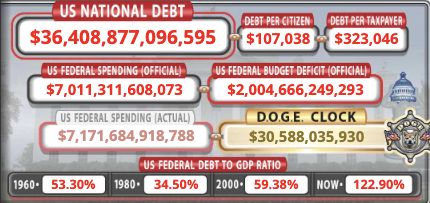
Golden Growth – The Golden Age would also need to see some Golden Growth. One area that’s helped our growth is government spending. Every dollar the government spends in the economy contributes to growth. If you take away some of this govt. spending you take away some of the growth in the economy. Unfortunately, we’ve been spending more than we make and deficit spending has gotten out of control. We make $5 Trillion per year in revenue as a country but spend $7 Trillion. That has ballooned our nation’s debt up to $36.4 Trillion today, according to the USDebtClock.org. The answer of course is to reduce government spending, but like I said, that will limit the growth of the economy.  

Trump signed an executive order to create the Department of Government Efficiency (DOGE) to make these cuts. The cuts they impose will need to be significant in order to make a dent in the deficit. Other administrations have tried this. I remember being excited about how the Simpson-Boles committee was suggesting ways to balance the budget for Obama, but it never materialized. The cuts DOGE needs to make may be unpleasant and will definitely slow growth, but if we don’t take our medicine now, the problem will be worse in the future. I’m skeptical Trump can reduce government spending and increase growth significantly…without some kind of ace in the hole. 

Golden Innovation – This is the ace in the hole. The only way a Golden Age happens is if innovation and technological advancements bring about new productivity and industries. Just like the innovations of electricity, steel, and assembly lines helped bring about the boom in manufacturing in the 50s, we need something similar to bring about another boom. 

What’s fascinating is the new advancements in artificial intelligence (AI) could be the ace in the hole we’re looking for. AI has a potential to change a lot about how we do things in the future. I’ve been slow to believe this, but after seeing the tens of billions of dollars companies are spending on AI infrastructure the last few years, I believe! Meta announced just last week they plan to spend $65 Billion on AI related costs in 2025. The dollars are staggering. 

Here’s a list of what could change as a result of AI:

1. Innovation across industries including health care, autonomous driving and financial technology.

2. Productivity increases in manufacturing, agriculture and customer service.

3. Better Predictions that help improved decision making.

4. New Industries like data science, AI development, and robotic maintenance will help replace jobs that will be automated.

5. Revitalizing Education could reduce the cost of education.

6. More use cases we haven’t even thought of yet…

The bottom line is I don’t know if we will see an Economic Golden Age the next four years, but there is one coming, and we don’t want to miss out in our portfolios.

We’ve been investing in some of the companies at the forefront of this AI race in our Growth Stock Portfolio. Some of them have seen tremendous growth due to the hope of the AI boom. However, as I write this, some of the best growth names of the last several years, and the stock market in general, are down big today. A new competitor in China, DeepSeek, has claimed they have found a new and less expensive way to develop AI.

Some are saying the AI bubble just burst, others are saying to buy now because the AI opportunity is still in the early stages. Whose right?  I’m not sure. It just seems to be another example that what goes up foreverdoes eventually come down a little… right before it goes back up again. We largely stay invested through all the drama. 

We’ve seen two good years in a row for stocks fueled largely by the hope of AI. Time will tell if we get a chance for a 3-peat, like my LEAST favorite team in football, the Kansas City Chiefs. Whether this AI shift and potential Golden Age happens over the next 4 years or 40, we need to be invested in it. 

SMB Financial News

We grew yet again this last year! We now manage approximately $175 Million across our five advisors. With that growth comes additional work we need help with. We are once again looking to hire another admin assistant and future financial advisor to help us with these extra duties.

As I mentioned in our last email, Jeremiah and his wife Alicia are expecting yet another child to add to the brood on the right. He will be out of the office for several weeks in March after the baby is born and I will be stepping into the operations role while he’s away.

No exciting news for me and my family, other than we got to visit the Florida Keys over the New Year. I was born in the Keys and spent the first 9 years of my life down there. It was an incredible trip seeing old familiar sites (like the Tamarind tree I used to climb after baseball practice 35 years ago!), getting out on the water to snorkel, and visiting family still down there.

It was a great vacation because it helped me rest up for another year of serving our great clients. We are so grateful for the incredible relationship we have with  all of you. Please don’t hesitate to contact us if you need anything. We hope to  talk with everyone soon.

Thanks for reading,

Tim Porter, CFP® 

The Time Has Come

The time has come to make a change. The time has come to turn the page. The time has come to face the music. The time has come to step up. The time has come to take a stand. 

Am I referring to politics? Ha! Not a chance. You can decide if the time has come for A New Way Forward or if the time has come to Make America Great Again.

The time has come… to sell some stocks. Or at least evaluate risk in the accounts.

The S&P 500 is at all time highs while we’re simultaneously facing several events that could have implications on our investments: the closely contested presidential election, wars in several places, and the Fed’s lowering of interest rates while trying not to stoke inflation.

We’ve been holding off on selling much the last few years, and we’re glad we did. The economy’s been able to weather high interest rates, profits have grown, jobs have been created, inflation is back in line, rates are dropping, and stocks have been rising, which has benefited everyone invested in them.

(Here’s a chart from Macrotrends.net showing stock market returns over the last 10 years. Not a bad run.)

But the time has come to sell some of those stocks.

Now, I’m not referring to SELL SELL SELL everything in the accounts like you’ve seen in movies. I’m thinking more like TRIM TRIM TRIM or SNIP SNIP SNIP.

Growth Stock Portfolio

We’ve already started trimming in our growth stock portfolio, selling Nvidia, which has grown to be an outsized position. We’ve been having conversations lately with clients about selling some of this stock and moving to a money market fund while waiting to invest until some event pushes the stock market back down again. We also want to “take out the trash” and sell some of the disappointing stocks like Zoom and Docusign.

Moderate Risk Funds Portfolio

In our moderate risk portfolio we’ve already been getting more conservative by selling normal stock funds and exchanging them with buffered funds that limit downside risk. These funds still capture upside when the market does well like it has the last few years. The trimming also gives us an opportunity to “take out the trash” in this portfolio and sell some of our underperforming funds.

The time has come to get more conservative and SELL. After the next dramatic headline, the time will come to BUY stocks once again. We’ll keep you posted when that happens. 

Exciting News

We had some very exciting news recently! The newest member of our team, Lindsey Cason, expanded her family August 31st and had her first baby, Lydia Cason. Mom and baby are doing well and Lindsey will be back in the office towards the end of the year.

While Lindsey and Nolan are trying to figure out how to care for their first baby, Jeremiah and his wife, Alicia, are having their fifth. Yes, I said FIFTH! Please pray for them! Due date is in March. 

It’s getting crazy around here and SMB may need to expand and start a daycare in one of our spare offices if this keeps up. 

I’m the odd one out. My wife and I are not expecting, but it feels like just the other day we were. Our 2 year old, Charlie, is now the mascot of our family.

Until next time!

Thanks for reading,

Tim Porter, CFP®

Play it by Ear

I can’t remember a time when I’ve seen so many pictures of an ear in the news. The term play it by ear is not usually meant to be literally about an ear, but I have a feeling that the Trump campaign will be doing just that, playing it by ear, until the election in November after last weekend’s failed assassination attempt. 

The horrific event that nearly killed the former president, but did end up killing two others (including the shooter), could end up being a boost to Trump’s poll numbers according to the NY Post. To be sure, we will continue to see Trump’s campaign play, and then replay, the video of Trump taking it in the ear. 

The term play it by ear actually means to do something without a detailed formula, or to wait and see before making a decision. Some overly cautious people may recoil at the idea of playing it by ear because it sounds reckless or irresponsible to them. But it’s used quite a bit in all kinds of areas:

Buying a home – Playing it by ear can be advantageous to buyers as they wait for the right price, the right rate, or the right home to come along before making a decision.

Interest rates – Jerome Powell and the Federal Reserve are playing it by ear as they weigh the advantages and disadvantages of cutting rates. A cut in September is all but guaranteed according to the experts, but future cuts are not as certain. 

Politics – Democrats are playing it by ear as they weigh Biden’s chances of beating Trump in November. Rep. Adam Schiff is apparently done playing it by ear as he’s now calling for Biden to be replaced. 

Playing it by ear is also used in financial planning and investing:

Planning for Retirement – Playing it by ear means having adaptable expectations in or near retirement because of unpredictable circumstances. While we try to predict what our clients will have to live on in retirement (see example below), sometimes they have to play it by ear because they won’t know the exact dollar amount they’ll have to live on until ~90 days before retirement.

Investing in Stocks – Playing it by ear means waiting for stocks/funds to drop before buying into them and playing it by ear also means waiting to let the stocks/funds run up before trimming them. After playing it by ear the last few years we’ve trimmed and are trimming positions for the eventual pullback.

Taxes – Playing it by ear means being willing to adjust your taxable income in retirement from year to year because of future tax changes. For example, the individual income tax cuts from the Tax Cuts and Jobs Act (TCJA) of 2017 are set to expire after 2025. 

While the stock market has been great in 2023 and 2024, we are well aware of the uncertainty that awaits us later this year with interest rates, an election, and geopolitical tensions.

While we wait to see what the uncertainty brings us, we know that uncertainty can bring opportunity. We’ve been trimming positions in client accounts in anticipation of the coming pullback and will look to reinvest at that time. I can’t predict the timing of the pullback, just that we will see another one in the future and we want to have some assets set aside for that day. 

I guess you could say we’re playing it by ear. 

Kaiser Permanente Retirement Seminars

It appears the Kaiser Permanente presentations are back on again! We’re preparing to  team up again with KaiPerm Credit Union to begin offering retirement seminars in two KP locations on either side of Portland. More details will be coming shortly but the dates look to be about a month or two out. 

We’re excited to crank up the 7 Deadly Sins of Retirement presentation again and to help KP employees make good decisions with their finances. Hope to see some of you there!

Thanks for reading,

Tim Porter, CFP®

Magic Number

How much will you need to retire? What’s the magic number you’ll need to save to consider retiring? 

This is a big question for half of my clients who are still working. This number can be motivating, or for most Americans who are way behind, it can be depressing.

So how does one figure out what their magic number is? You could always google it.

If you do that you’ll come to this figure – $1.46 Million.  

Northwestern Mutual interviewed 4500 people in January this year and that was the average dollar amount people thought they needed to save to retire.

After thinking about it, honestly, it’s not a terrible number.

As a Financial Planner, I’m supposed to say “rules of thumb” are garbage for financial planning and you should have a specific, custom, personalized, tailored, complicated, EXPENSIVE… financial plan done with an expert like myself.

We’re happy to do that for people, but most don’t need a hundred-page financial plan. They just need something simple to shoot at. After all simplicity is the ultimate sophistication (Da Vinci) and everything should be as simple as possible, but not simpler (Einstein).

So, if you’re near retirement and just looking for a number, you’re good to go. Go figure out how to save $1.46 Million by the time you’re in your mid-sixties.

For the rest of you who want a bit more detail, let’s look at some rules of thumb to figure out your magic number. 

(Below is not my child. I tried to get my almost 2-year-old, Charlie, to give a thumbs up for a picture, but I guess he’s not a thumbs up kind of guy yet.)

Current Income

What is your desired income in retirement? 

Rule of thumb #1 – Use your current income. 

No need to think long and hard about your budget in retirement, just use your current income. You’ve lived on it this long, it will probably be more than enough when you retire. Typically you need less income when you retire since you wouldn’t be saving or spending as much on gas or work expenses, but to make life easy, just use your current income.

Retirement Income Sources (social security, rental income, pensions…)

How much will you get from Social Security? 

Rule of thumb #2 – Use the average SS payout of $20,000/yr. 

If you don’t know, or don’t want to login to SSA.gov to find out your specific payout, then use the average payout. If you’re married, double it. That will get you started on what you’ll have coming in.

Add in any pensions (this is important for my Kaiser Permanente clients), rental income, part-time work, or other retirement income you’ll have to get your a total retirement income. 

Investment Income

How much income will you need to generate from your savings/investments? 

Rule of thumb #3 – Subtract retirement income from current income.

Current Income – Retirement Income = Needed Investment Income

Example: If you currently live on $100,000 in income and you’ll have $20,000 from social security each year then you’ll need to generate $80,000 in investment income to cover your needs.

Multiply by 20

How much savings will you need to get your investment income?

Rule of thumb #4 – Mulitply your investment income by 20 to get your magic number.

Example from above: $80,000 x 20 = $1,600,000

Pretty close to the number you would have gotten if you googled it! 

The Bottom Line

The bottom line is there is no magic to THE number. We have retired clients with much less than the magic number who are living a fantastic life in retirement. We also have clients with many times this magic number who are worried about how much they have. 

The number is always changing, it’s always elusive, and it seems to always be more than you will have. The best thing I have seen people do in 19 years is to pick a realistic number and figure out how much you need to work and save to get there. Then, when you get to retirement age, and the magic number is assuredly different than what you thought it was going to be, figure out how to live on the income it generates.

The average American has $88,000 saved for retirement. It seems counterintuitive to stress about whether your number is $1.46 or $1.56 Million. 

Use some rules of thumb to figure out how much you’ll need, or call us and let us do the work for you.

Our specialty is helping simplify the financial/retirement plan down to one page, FOR FREE! Click below to see an example of our Can-I-Retire Spreadsheet. It’s how we keep score of retirement for clients and help them answer the question, “Can I retire?”

Let us know if we can create one of these for you.

Thanks for reading,

Tim Porter, CFP®